
The Kubler-Ross Five Stages of Grief
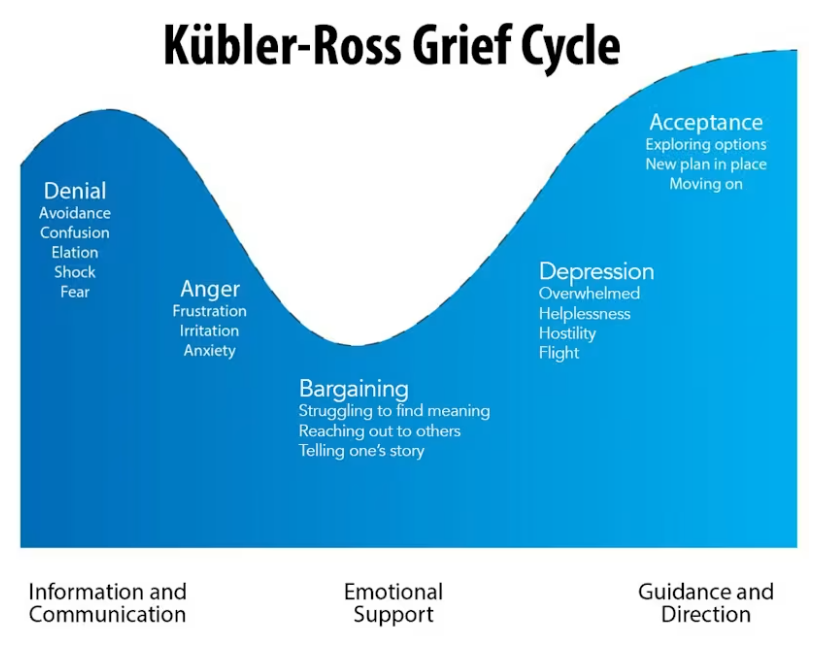
The stock market–especially those stocks involved in the artificial intelligence trade–is correctly violently. This week, the selling has branched out to sectors of the market that have little or nothing to do with A.I. According to this diagram, investors seem to be approaching or are at the Depression stage, which involves the thought that they have to sell everything before they lose it all. This surrender may feel like the best option, but it likely will produce the worst outcome.
There are many concerns hanging over the stock market right now, but we shouldn’t lose focus. The euphoria we experienced earlier this year was always going to end at some point. Markets always go too far in either direction. Euphoria feels great, despair doesn’t. We are approaching what looks like a pessimistic extreme right now. Companies are reporting very strong earnings, oil prices are down 20% from recent highs. The situation is not as bad as it seems. The problem is uncertainty, which the market hates. The uncertainty centers on A.I. spending and whether that spending will ever produce a profitable return. The race for A.I. dominance between the U.S. and China is also a worry. However, that worry might also be our salvation since we cannot afford to cede dominance A.I. to China. For reasons of national security, we have to continue to build out the required infrastructure. Nvidia, the marquee name in artificial intelligence and also the source of all this angst, recently reported earnings and an outlook that would have delighted investors had company founder and CEO Jensen Huang not been forced to resign. There is no slackening of demand for NVDA’s product, but there is concern that the financing arrangements that NVDA has been offering to its customers will need to be curtailed.
If oil prices are the key component of this persistent inflation, then oil price relief should result in lower inflation. There has been almost universal belief that the Fed will raise rates again in December and two more times next year. The December rate hike is probably going to happen and it certainly already is baked into the investment math, but I’d question the need for more hikes next year. Inflation has been elevated for most of this year and so that year-over-year comparisons have been an issue. However, in 2027 we will be comparing the rate of inflation to the 2026 rate. That comparison will likely show flat to declining inflation. Inflation may still be above the Fed’s 2% goal, but the rate of change will be close to zero, zero, or less than zero.
The market has entered a correction, which is defined as a 10% move down from the highs. This of course is a deviation from history, which has showed us that the 4th q is the best quarter of the year, or that the markets generally do well after midterm elections. The stock market often makes fools of those who attempt to predict direction. Are we at the bottom? Honestly, I don’t know. The stock market this year has been powered by optimism regarding artificial intelligence. That optimism is gone. NVDA is by every measure historically cheap, but everyone seems willing to let someone else be the first buyer.
The path to recovery will be built on certainty. Resolving the questions overhanging the market will take some time, but the consensus that next year was going to be difficult is being replaced by the understanding that we are experiencing that difficulty now, which could mean better things for 2027.
Seward
The opinions voiced in this material are for general information only and are not intended to provide specific advice or recommendations for any individual. All performance referenced is historical and is no guarantee of future results. All investing involves risks including loss of principal. No strategy assures success or protects against losses.
The economic forecasts set forth in this material may not develop as predicted and there can be no guarantee that strategies promoted will be successful.
The information presented is for educational and informational purposes only and is not intended as a recommendation or specific advice. Cryptocurrency and cryptocurrency-related products can be volatile, are highly speculative and involve significant risks including: liquidity, pricing, regulatory, cybersecurity risk, and loss of principal.